

How We Evaluate Casino Websites
We do not start an evaluation by asking whether a casino is simply “good” or “bad”.
Instead, we break each topic into individual factors that may genuinely affect a player’s decision. We then check specific claims, find sources that are suitable for those claims, compare the available information and show what could — and could not — be confirmed.
Our aim is not to produce another confidently written casino review. We want readers to see what a conclusion is based on, where the evidence is strong and where uncertainty remains.
What Our Evaluations Are Based On
Every evaluation starts with specific questions rather than an overall impression of a brand.
For example, if a page is about a bonus, relevant factors may include:
- bonus amount;
- minimum deposit;
- wagering requirements;
- expiry period;
- game restrictions;
- withdrawal conditions.
If the topic is payments, the factors may instead include payment methods, minimum amounts, withdrawal times, withdrawal limits, fees and KYC requirements.
There is therefore no single fixed checklist that is automatically applied to every page. Depending on the topic, we normally select around 5–8 factors that may materially affect the user’s decision.
Each factor can also contain several separate parameters.
For example, a “bonus” is not one fact. The bonus amount, minimum deposit and wagering requirement are separate claims, and each one is checked independently.

How We Decide Which Factors Matter Most
Not every factor has the same influence on a decision.
We use three levels of importance:
Critical — the result for this factor may be important enough to change the user’s decision on its own.
High — the factor has a strong influence on the decision but is normally considered together with other factors.
Medium — useful when comparing options, but unlikely to decide the issue on its own.
This distinction matters when we form the final conclusion.
Several positive results for less important factors should not automatically outweigh a serious problem with a critical factor.
We do not assign mathematical weights to these levels and we do not turn them into a single overall casino score.
How We Choose Sources
We do not treat a source as universally “good” or “bad”.
The more useful question is:
Is this source suitable for checking this specific claim?
Different types of information require different types of evidence.
- Licence and legal status: regulators and official registers.
- Bonus conditions: Bonus Terms, Terms & Conditions and official promotion rules.
- Payment and withdrawal limits: payment sections, Withdrawal Terms and Help Centre pages.
- Game specifications: the game provider or official game documentation.
- Practical player experience: independent complaints, forums, review platforms and documented user experiences.
A casino’s own website may be an appropriate source for checking its published minimum deposit.
However, it is not independent evidence that every real withdrawal is completed within the timeframe advertised by the operator.
The reverse is also true. A player review may be a useful signal about a withdrawal problem, but it is not the primary evidence we would use to establish a company’s formal legal status or the exact wording of its Terms & Conditions.
One Review Does Not Establish a Pattern
When looking at practical player experiences, we also consider repetition and independence.
One review is a single signal.
Several similar reports may indicate a pattern.
If the same type of issue repeatedly appears across several independent platforms, that provides stronger practical evidence.
Even then, user reports do not replace an official source when the question concerns a formal condition, licence or exact contractual value.
A Brand Claim Is Not Independent Confirmation
If a casino states:
“Withdrawals are processed within 24 hours.”
we may be able to confirm one thing: the operator publishes that timeframe.
That does not independently prove that every withdrawal is actually completed within 24 hours.
For this reason, we separate:
- what the brand claims;
- what primary documents establish;
- what can be independently confirmed;
- what conclusion the available evidence supports.
Information published by the brand itself is not excluded from the evaluation. Its origin simply needs to remain clear to the reader.
What Our Verification Statuses Mean
✅ Confirmed
We found sufficiently reliable evidence that directly supports the parameter being checked.
🟡 Partially Confirmed
The main part of the information can be established, but a meaningful part of the value, condition, range or applicability remains unclear or is only partly supported.
❔ Could Not Be Confirmed
After checking the available evidence, we did not find enough reliable information to establish the claim with sufficient confidence.
This does not automatically mean the claim is false.
⚖️ Conflicting Information
Suitable sources provide different answers and further checking does not resolve the disagreement with sufficient confidence.
❌ Disproved
We found sufficiently reliable evidence that directly contradicts a specific claim being checked.
“Could not be confirmed” and “disproved” are not the same thing.
One Verification Example from Start to Finish
What We Checked
We looked at the claimed connection between Kaboom77, Boom Line B.V. and Curaçao licence OGL/2024/599/0274.
What We Found
The Curaçao Gaming Authority confirms that Boom Line B.V. is a Curaçao company associated with licence number OGL/2024/599/0274.
That provides evidence that the company and licence exist.
However, it does not automatically establish that Kaboom77 itself operates under that licence.
How We Compared the Information
There are two separate claims here:
- Boom Line B.V. is associated with licence OGL/2024/599/0274.
- Kaboom77 itself operates under that licence.
The first claim can be supported through official Curaçao Gaming Authority information.
The second requires evidence connecting the specific Kaboom77 operation or domain to the licensed operator.
Verification Status
❔ COULD NOT BE CONFIRMED
Why
The company and licence can be verified, but the available official evidence we reviewed does not establish the required connection between Kaboom77 itself and that licence strongly enough for us to mark the claim as confirmed.
What This Means for the User
Instead of simply displaying the words “Curaçao licence”, we separate the part that can be verified from the part that remains uncertain.
What We Do When Sources Conflict
When sources conflict, we check:
- when each piece of information was published;
- which source is closest to the primary source for that specific parameter;
- whether the information may have changed over time;
- whether the sources refer to exactly the same brand, domain or offer;
- whether additional evidence is available.
If the conflict cannot be resolved reliably, the status remains:
⚖️ CONFLICTING INFORMATION
Why Some Information Changes Over Time
Information that may change includes:
- bonuses and promotions;
- wagering requirements;
- minimum deposits;
- deposit and withdrawal limits;
- payment methods;
- game availability;
- promotion conditions;
- withdrawal rules.
This is why the date of a check matters.
One Fact Base Across the Site
Verification results are stored in a shared Fact Base.
The purpose is to prevent the same parameter from receiving different values in different articles.
If a parameter has already been researched, other relevant pages can use the same current result rather than starting the same research again without a reason.
What Our Verification Percentage Means
The verification percentage measures how much of the information included in a specific investigation is supported by evidence.
- Confirmed: 1 point.
- Partially Confirmed: 0.5 points.
- Conflicting Information: 0.5 points.
- Could Not Be Confirmed: 0 points.
- Disproved: 0 points.
For example:
1 + 1 + 0.5 + 0 = 2.5
2.5 ÷ 4 = 62.5% verified
Parameters are not removed from the calculation simply because we failed to find enough information about them.
The overall verification percentage for a page topic is calculated as the arithmetic mean of the percentages for all critical factors, with each critical factor receiving equal weight.
What the Percentage Does Not Mean
A 62.5% verification result does not mean:
- the casino is 62.5% safe;
- the casino has a quality score of 62.5%;
- there is a 62.5% chance of receiving a withdrawal;
- the casino deserves a rating of 6.25/10;
- there is a 62.5% chance of winning;
- the casino has passed a legal assessment.
It only shows how much of the information required for that particular investigation was sufficiently supported by the evidence available to us.
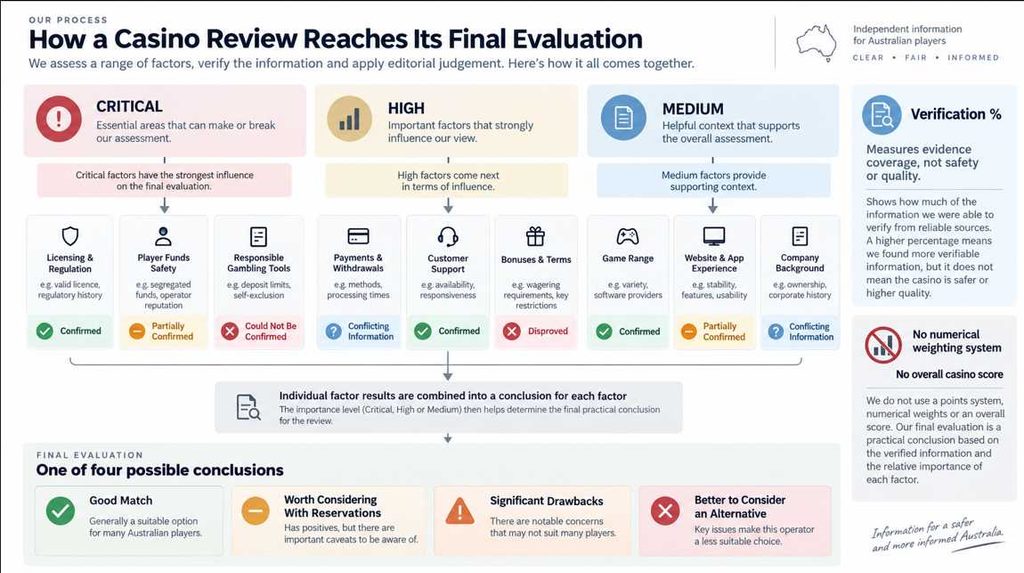
How We Reach the Final Conclusion
The final conclusion is not written separately based on a general impression.
We first evaluate the individual parameters inside each relevant factor.
For each parameter, we consider:
- what exactly is being claimed;
- what evidence was found;
- whether the source is suitable for that particular claim;
- whether the available information conflicts;
- which verification status the evidence supports.
Our Four Final Conclusions
Good Match
The critical factors meet the requirements relevant to the topic, there are no serious unresolved conflicts, and any weaknesses mainly concern less important areas.
Worth Considering With Reservations
There is no clear failure of a critical factor, but important limitations or meaningful uncertainty remain and should be considered before making a decision.
Significant Drawbacks
There is a serious problem with a critical factor, several important factors perform poorly, or confirmed limitations materially weaken the option being assessed.
Better to Consider an Alternative
This conclusion is used only when there is sufficient evidence — for example, when a critical factor clearly fails or a serious confirmed fact materially undermines the offer relevant to the page topic.
We do not use this conclusion simply because information is missing.
How Factors Are Weighted
Critical → High → Medium
A serious failure involving a critical factor may outweigh several successful results involving medium-level factors.
However, we do not assign fixed mathematical weights to these categories and we do not calculate a universal overall casino rating.
What We Do Not Do
- treat an advertising claim as evidence on its own;
- hide missing information;
- replace unknown information with assumptions;
- describe an unconfirmed claim as confirmed;
- choose a source simply because it gives a convenient result;
- hide meaningful conflicts between sources;
- describe a third-party website as an official source;
- use player reviews as the main evidence for formal contractual conditions;
- treat missing evidence as proof that a feature does not exist;
- claim to have personally tested a product when no such testing took place.
Limitations of Our Methodology
Information may change after we check it.
Some information may only be visible after registration or account login.
Certain conditions may depend on the user’s location.
Even primary sources can sometimes be incomplete or ambiguous.
For these reasons, a verification status represents the strength of the evidence available at a particular point in time, not an absolute truth that is guaranteed to remain unchanged.
Why We Use This Approach
The project grew out of a simple problem: different reviews of the same casino can publish different figures while giving readers very little information about where those figures came from.
Stan, who founded CorrectCasinos.com in 2018, takes a different approach: instead of starting with a verdict, the aim is to show what could actually be checked and how strongly the available evidence supports it.
Why We Show Our Sources
A source link allows readers to see:
- where a specific claim came from;
- what the original source actually says;
- whether the source is official or independent;
- whether the source is suitable for the parameter being checked;
- where the information is supported;
- where uncertainty remains.
Readers can see the path from the original claim to the evidence, verification status and practical conclusion — and check that path for themselves if they wish.